 fr
fr en
en
Certification Lean Six Sigma Black Belt Certified
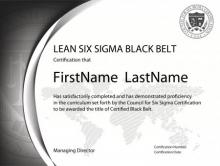
In quality management, Black Belt certification represents an advanced level of knowledge of the Lean Six Sigma methodology. Becoming Black Belt certified means mastering the tools and processes that improve your company's performance and productivity (Lean) while applying the management methodology (Six Sigma). It also means being able to manage continuous improvement projects with teams at all levels. Finally, as a Lean manager, it demonstrates your ability to establish a framework for operational excellence.
What is Lean Six Sigma Black Belt certification?
The Level 3 Lean Six Sigma Black Belt certification awarded by our partner, the Council for Six Sigma Certification (CSSC), validates your command of every aspect of the Six Sigma Body of Knowledge. This includes understanding the methodology's concepts and principles, together with its supporting systems and tools. Black Belt certification also demonstrates your ability to lead a Lean team, foster group dynamics and assign roles and responsibilities to team members. Finally, it validates your effective application of the DMAIC model, your fundamental knowledge of Lean enterprise concepts and your ability to identify tasks that do not add value.
Why earn Lean Six Sigma Black Belt certification?
With the evolution of Lean practices, many service companies have adopted Lean Six Sigma relatively early compared with industrial companies. Since mastery of the discipline varies between organisations, it is reasonable to ask which certification level matters most: Yellow Belt, Green Belt or Black Belt. It is also worth considering why someone should seek the methodology's highest level of certification when organisational processes remain poorly understood and lack clarity.
Lean Six Sigma Black Belt certification means knowing and mastering all the tools and techniques applicable to work processes. This highly sought-after and valuable qualification equips you with the following advanced skills:
- Identify and describe a process to understand it in detail and improve it effectively;
- use process documentation to build momentum around an improvement project and enhance communication;
- define achievable direct benefits by identifying all forms of process dysfunction and significantly reducing them;
- measure process improvement through monitoring and data collection;
- interpret results and analyse data using statistical tools such as control charts;
- assess the quality of process deliverables and predict defect rates;
- identify an improvement, simulate its effects and prioritise improvement activities according to their impact;
- understand methods for collecting data as quickly as possible when it is unavailable, even if the dataset is incomplete or imprecise.
Although some of these skills may not be applicable to every company's work processes, mastering them helps you identify the sources of problems quickly and determine the best ways to resolve them. It also provides the knowledge needed to test hypotheses using accurate data, since improvement is impossible without measurement.
Training related to Lean Six Sigma Black Belt Certified
CSSC is a registered trademark of The Council for Six Sigma Certification (S.S.C).